The Internet's Premier Classical Music Source
Related Links
-
Introduction
Acoustics
Ballet
Biographies
Chamber Music
Composers & Composition
Conducting
Criticism & Commentary
Discographies & CD Guides
Early Music & HIP
Fiction
History
Humor
Illustrations & Photos
Instrumental
Lieder
Music Appreciation
Music Education
Music Industry
Music and the Mind
Musical Forms
Opera
Orchestration
Reference Works
Scores
Thematic Indices
Theory & Analysis
Vocal Technique
Search Amazon
Recommended Links
Site News
Site Search
Follow us on


Affiliates









Books About Music
History
This list provides an overview of books concerning general aspects of music history, or specific examinations of periods, places, or styles.
We welcome feedback, suggestions, additions, and corrections to this information.
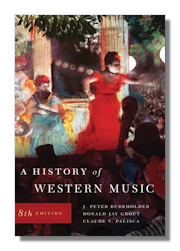
- A History of Western Music. J. Peter Burkholder, Donald Jay Grout, Claude V. Palisca. W.W. Norton & Company. 2009. ISBN 0393931250 (hardcover).
- The Eighth Edition of A History of Western Music is a vivid, accessible, and richly contextual view of music in Western culture. Building on his monumental revision of the Seventh Edition, Peter Burkholder has refined an inspired narrative for a new generation of students, placing people at the center of the story. The narrative of A History of Western Music naturally focuses on the musical works, styles, genres, and ideas that have proven most influential, enduring, and significant – but it also encompasses a wide range of music, from religious to secular, from serious to humorous, from art music to popular music, and from Europe to the Americas. With a six-part structure emphasizing the music's reception and continued influence, Burkholder's narrative establishes a social and historical context for each repertoire to reveal its legacy and its significance today.
- Concise History of Western Music. Barbara Russano Hanning, Donald Jay Grout. W.W. Norton & Company. 2009. ISBN 0393932516 (hardcover).
- Based on A History of Western Music, by J. Peter Burkholder, Donald Jay Grout, and Claude V. Palisca, the Concise History of Western Music, Fourth Edition, offers authoritative coverage of the essential works and genres in Western music history. By setting musical events into a memorable historical and cultural context, Concise History of Western Music provides a history students will read and remember.
-
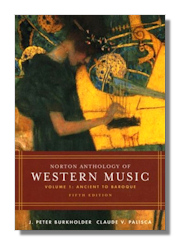
Norton Anthology of Western Music: Volume 1: Ancient to Baroque. J. Peter Burkholder, Claude V. Palisca. W.W. Norton & Company. 2005. ISBN 0393979903 (paperback).
Norton Anthology of Western Music: Volume 2: Classic to Twentieth Century. J. Peter Burkholder, Claude V. Palisca. W.W. Norton & Company. 2005. ISBN 0393925625 (paperback). - This comprehensive collection of scores illustrates every significant trend and genre of Western music from antiquity to modern times, with a strengthened emphasis on twentieth-century music. The ideal companion to A History of Western Music, this anthology includes historically-significant scores, with a strengthened emphasis on twentieth-century music. Highlights of the repertoire include new works from all periods: more contrasting virelais, ballades, and other chansons from the fourteenth through the sixteenth centuries; large-scale choral works, including Gabrieli's In ecclesiis, Lully's Te Deum, Haydn's Creation, and Prokofiev's Alexander Nevsky; more opera, including Norma, Les Huguenots, and Madama Butterfly; orchestral and chamber works by Schubert, Schumann, Brahms, Dvořák, and Tchaikovsky; and new twentieth-century works by Satie, Bartók, Milhaud, Prokofiev, Varèse, Hindemith, Cowell, Cage, Feldman, Stockhausen, Boulez, Berio, Reich, Adams, Ligeti, Schnittke, and Michael Daugherty.
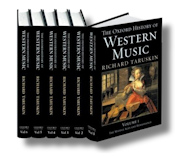
- Oxford History of Western Music. Richard Taruskin. Oxford University Press. 2005, 2009. ISBN 0195169794 (hardcover), 0195386302 (paperback).
- The 6-volume Oxford History of Western Music is a magisterial survey of the traditions of Western music by one of the most prominent and provocative musicologists of our time. This text illuminates, through a representative sampling of masterworks, those themes, styles, and currents that give shape and direction to each musical age. Taking a critical perspective, this text sets the details of music, the chronological sweep of figures, works, and musical ideas, within the larger context of world affairs and cultural history. Written by an authoritative, opinionated, and controversial figure in musicology, The Oxford History of Western Music provides a critical aesthetic position with respect to individual works, a context in which each composition may be evaluated and remembered. Taruskin combines an emphasis on structure and form with a discussion of relevant theoretical concepts in each age, to illustrate how the music itself works, and how contemporaries heard and understood it. It also describes how the context of each stylistic period – key cultural, historical, social, economic, and scientific events – influenced and directed compositional choices.
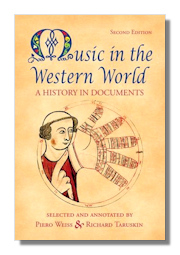
- Music in the Western World. Piero Weiss, Richard Taruskin. Schirmer. 2005, 2007. ISBN 0195097629 (hardcover), 053458599X (paperback).
- The 2nd edition of this classic anthology assembles over 200 source readings, bringing to life the history of music through letters, reviews, biographical sketches, memoirs, and other documents. Writings by composers, critics, and educators touch on virtually every aspect of Western music from ancient Greece to the present day.
-
The History of Classical Music and the History of Opera. Richard Fawkes (Author), Robert Powell (Reader). Naxos Audio Books NAX25712 (8CDs). 2002. ISBN 9626342579 (audiobook).
The History of Classical Music. Richard Fawkes (Author), Robert Powell (Reader). Naxos Audio Books NA414012 (4CDs). 1999. ISBN 9626341408 (audiobook).
The History of Opera. Richard Fawkes (Author), Robert Powell (Reader). Naxos Audio Books NA417612 (4CDs). 1999. ISBN 9626341769 (audiobook). -
The History of Classical Music is the story of over 1000 years of Western classical music and composers. From Gregorian Chant to Henryk Gorecki, the first living classical composer to get into the pop album charts, here is the fascinating story of over a thousand years of Western classical music and the composers who have sought to express in music the deepest of human feelings and emotions. Polyphony, sonata form, serial music – many musical expressions are also explained – with the text illustrated by performances from some of the most highly praised recordings of recent years.
The History of Opera traces the history of opera from its origins in the 16th century to the 21st century and also looks at the operetta. Since its origins in the sixteenth century, opera has been an extravagant, costly affair, arousing great passions. It has also produced some of the most sublime works of art, from Monteverdi to Wagner. Richard Fawkes traces the history of opera up to the present day on the first three CDs, and devotes the fourth to the history of operetta. Illustrated by 250 musical examples. Available separately.
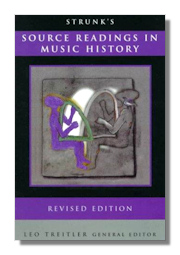
- Source Readings in Music History from Classical Antiquity Through the Romantic Era. W. Oliver Strunk, Leo Treitler. W.W. Norton & Company. 1950, 1995. ISBN 0393037525 (hardcover).
- Forty-five years after the appearance of the first edition, Oliver Strunk's monumental anthology of writings about music has been thoroughly revised and extended by a team of scholars working under the direction of musicologist Leo Treitler. For this new edition, seven specialists in music history have replaced some selections, added others, contributed new translations, and provided additional notes and introductions. An entire new section, covering the twentieth century, significantly enlarges the book's scope. Readers can now acquire a comprehensive picture of Western musical thought and ideas through the ages. Also available as separate volumes (see below). Read the Classical Net Review of this book.
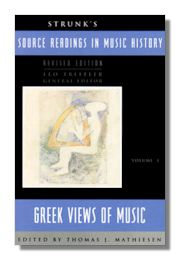
- Source Readings in Music History, Vol. 1: Greek Views of Music. W. Oliver Strunk (Editor), Thomas J. Mathiesen (Editor), et al. W.W. Norton & Company. 1997. ISBN 0393966941 (paperback).
- How did the ancient Greeks regard music? In many different ways, as the readings in Greek Views of Music reveal. This collection presents three entire treaties, as well as excerpted writings on music by Plato, Aristotle, and others. Included is the first English translation of Gaudentius's complete Harmonic Introduction, prepared by the volume's editor, Thomas J. Mathieson, who also revised the other translations in light of recent scholarship. These selections not only illuminate Greek thinking about music, they also help us understand ideas about music set forth by medieval and Renaissance writers and theorists.
- Source Readings in Music History, Vol. 2: Early Christian Period and the Latin Middle Ages. Oliver Strunk (Editor), James McKinnon (Editor), et al. W.W. Norton & Company. 1966, 1997. ISBN 039396695X (paperback).
- In The Early Christian Period and the Latin Middle Ages, we witness the merger of musica, then an abstract academic enterprise, and cantus, or practical music. The volume spans a millennium of writings, ranging from scriptural commentaries by St. Jerome and other fourth-century Church Fathers to an excerpt from Speculum musicæ, an extensive fourteenth-century treatise by Jacques of Liège. Along the way we read from the works of St. Augustine, Boethius, Hildegard of Bingen, Guido of Arezzo, Franco of Cologne, and a score of others, all in impeccable English translations prepared or revised by James McKinnon.
- Source Readings in Music History, Vol. 3: The Renaissance. Oliver Strunk (Editor), Gary Tomlinson (Editor), et al. W.W. Norton & Company. 1966, 1998. ISBN 0393966968 (paperback).
- The Renaissance era saw a significant ferment under the banners of humanism, discovery, and reform, deeply affecting music and the way it was understood. Writers of the time explored its links with grammar and rhetoric, reported on the music of non-European peoples, and debated the role of music in religious and other spheres. The forty-five readings chosen for this volume by Gary Tomlinson cover a gamut that includes composers, theorists, poets, philosophers, courtiers, scholars, kings, and popes. Through the eyes of Bembo and Byrd, Dufay and Erasmus, Peacham and Palestrina, Charles IX and Gregory XIII, Calvin and Castiglione, Aaron, Tinctoris, Morley, and Zarlino, we see the many worlds of music in the Renaissance.
- Source Readings in Music History, Vol. 4: The Baroque Era. Oliver Strunk (Editor), Margaret Murata (Editor), et al. W.W. Norton & Company. 1966, 1998. ISBN 0393966976 (paperback).
- Though traditionally labeled "Baroque," the seventeenth and early eighteenth centuries in music could as easily be termed "early modern," since many of the genres that are popular today-were established during that time. And as music itself was becoming more and more of a public affair, discussions and writings about music increased greatly. In The Baroque Era, Margaret Murata presents twoscore readings from a constellation of personalities whose thoughts and opinions help define the period for us. We hear, of course, from the composers (Monteverdi, Schütz, Rameau, Bach) and the theorists (Artusi, Simpson, North, Mattheson), but we also find the words of nonmusicians, ranging from the famous (Joseph Addison, Lady Mary Montagu) to the unknown "Truthful Reporter."
- Source Readings in Music History, Vol. 5: The Late Eighteenth Century. Oliver Strunk (Editor), Wye Jamison Allanbrook (Editor), et al. W.W. Norton & Company. 1966, 1998. ISBN 0393966984 (paperback).
- In The Late Eighteenth Century, Wye Jamison Allanbrook presents twenty-six readings that reveal how the music establishment of 1750-1800 saw itself. The era of Haydn, Mozart, and early Beethoven not only produced music of enduring appeal, it also gave us significant writings that explain how music should be composed, performed, listened to, and understood. Included are selections from the great German pedagogical treaties of Quantz (on playing the flute), C.P.E. Bach (keyboard), Leopold Mozart (violin), and Kirnberger and Koch (on composition); opinions about opera by Rousseau, Diderot, and Gluck; ideas on expression by W.A. Mozart and G. de Staël; and historical/descriptive writings of Forkel, Charles Burney, and Susannah Burney.
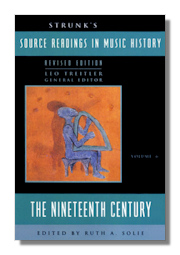
- Source Readings in Music History, Vol. 6: The Nineteenth Century. Oliver Strunk (Editor), Ruthg Solie (Editor), et al. W.W. Norton & Company. 1966, 1997. ISBN 0393966992 (paperback).
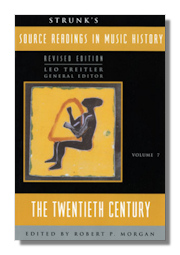
- Source Readings in Music History, Vol. 7: The Twentieth Century. Oliver Strunk (Editor), Robert P. Morgan (Editor), et al. W.W. Norton & Company. 1966, 1998. ISBN 039396700X (paperback).
- Twentieth-century music has been described as complex, vital, diverse, uncertain, experimental, self-conscious, innovative-the list is long and growing. Composers have been both credited with and accused of always searching for something "new," writing works that are mechanistic but romantic, meaningful but unskilled, beautiful but ugly! In The Twentieth Century, Robert P. Morgan helps us grasp the flavor of the era by presenting forty-five readings from the period, nearly all written by active participants in the musical developments of the time. Thus we tune in to the voices of some thirty composers-from Busoni to Babbitt, Ives to Xenakis, Satie to Stravinsky-and learn from performers Anderson and Landowska, philosopher-critics Adorno, Dahlhaus, and Meyer, and writers Cocteau, Barthes, and Eco.
Norton Introductions to Music History
- This series presents the music of the Western world to the nonspecialist in six original, strikingly illustrated volumes. In each an outstanding musicologist surveys the music of a specific period, discusses its major composers, and examines the forces that influenced and helped shape the œuvre. The series is designed to carry on the tradition of excellence in musical scholarship that Norton has established in this field. Designed to accompany and supplement each author's survey is an anthology of musical examples that serve as a score resource for all the works discussed in depth in that volume.
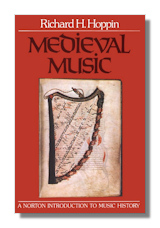
- Medieval Music. Richard H. Hoppin. W.W. Norton & Company. 1978. ISBN 0393090906 (hardcover).
Anthology of Medieval Music. Richard H. Hoppin (Editor). W.W. Norton & Company. 1978. ISBN 0393090809 (paperback).- This book will be useful to the college student who wants more information than can be gleaned from a survey of all Western music but may not have time for an intensive study of the entire medieval repertory. The book will prove interesting and helpful to the increasing number of amateurs who, through both live and recorded performances, have come to know and love the strangely beguiling qualities of medieval music. Perhaps, in addition, it may contribute to a wider realization that the Middle Ages produced music worthy of the same careful study and admiration long accorded to its masterpieces of literature, art, and architecture.
The Anthology will also undoubtedly provide a welcome addition to the heretofore severely limited repertoire of medieval pieces available in contemporary notation. Most of the seventy-one works have been freshly transcribed, and all have been newly engraved for this collection. In choosing the works for inclusion in this collection, many of which have been available in a modern edition, Professor Hoppin ranged widely throughout the gamut of medieval music forms. For example, all the movements for the Solemn Mass of Easter Day are offered along with typical troubadour and trouvère works. Examples of sequence, clausula, organum, and conductus are presented together with Latin and English love songs, motets, rondeaux, and ballate. The result is a history of medieval music in itself. there ar no snippets or frustrating samples, but only complete works or – at least – integral movements of larger works. All the characteristic styles of the period are represented, and text translations accompany each work.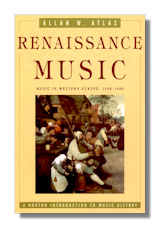
- Renaissance Music: Music in Western Europe, 1400-1600. Allan W. Atlas. W.W. Norton & Company. 1998. ISBN 0393971694, (hardcover).
Anthology of Renaissance Music: Music of the Fifteenth and Sixteenth Centuries. Allan W. Atlas (Editor). W.W. Norton & Company. 1998. ISBN 0393971708 (paperback).- Focused foremost on the music and then on the social, political, and economic forces that combined to produce it, this book is the ideal undergraduate textbook for music history classes covering the period from c. 1400 to c. 1600. Atlas's graceful, accessible prose illuminates musical concepts and historical details. A clear format and comprehensive content make Renaissance Music a true teaching and learning text, crafted to meet the needs of today's students discovering this music and its history for the first time.
The carefully-selected Anthology contains a total of 102 works of complete movements by some 75 composers. Spanning the period from the early fifteenth century to the late sixteenth, the anthology features all of the era's important forms and many minor ones, including carols, motets, Mass movements, Anglican services, a Magnificat setting, chansons, frottole, Lieder, madrigals, and others. For each selection, the best available edition has been reproduced; where no satisfactory edition existed, the piece has been specially set for this volume. Inclusive and practical, the Anthology of Renaissance Music is a remarkable tool for students and teachers, for use with or without its companion text.
- Baroque Music: Music in Western Europe, 1580-1750. John Walter Hill. W.W. Norton & Company. 2005. ISBN 0393978001 (hardcover).
Anthology of Baroque Music. John Walter Hill. W.W. Norton & Company. 2005. ISBN 039397801X (paperback).- This essential addition to the Norton Introduction to Music History series provides a comprehensive introduction to the music of the Baroque, incorporating discussions of culture, religion, and political history with in-depth analysis of musical compositions. The narrative is complemented by a wide range of music in both the text and the accompanying Anthology of Baroque Music; the works included reflect the innovations and great stylistic diversity of music during this dynamic period.
The Anthology of Baroque Music contains 130 carefully selected scores for the compositions highlighted in Baroque Music. All of the scores are in new editions and English translations are provided for all foreign-language texts. The music provided in the Anthology and on the accompanying Web site ranges from lute, harpsichord, and organ music to concertos, cantatas, oratorios, and operas.
- Classical Music: The Era of Haydn, Mozart, and Beethoven. Philip G. Downs (Editor). W.W. Norton & Company. 1992. ISBN 039395191X (hardcover).
Anthology of Classical Music. Philip G. Downs (Editor). W.W. Norton & Company. 1992. ISBN 0393952096 (paperback).- In this, the fourth volume in the Norton Introduction to Music History series, Philip Downs traces the rise and decline of the "Classical" style from the birth of Haydn (1732) to the death of Beethoven (1827). He demonstrates the enormous diversity and constant change that characterized every aspect of music during this period. By dividing his text into twenty-year spans, Downs is able to trace the development of musical style. Within each span he looks at the social conditions and daily life of the musician, and the aesthetics and audience preferences in structures, performing combinations and styles. The lesser composers, or Kleinmeister, are observed, since they are the most accurate mirrors of their times. Haydn, Mozart and Beethoven receive full biographical scrutiny at each stage of their development. Copious music examples and abundant illustrations are also provided.
For the carefully selected anthology, the author of Classical Music has chosen representative works from the eighteenth and early-nineteenth centuries. All seventy-six selections – complete pieces, movements, or integral sections – are discussed at length in the companion text. All genres, styles, and instrumental combinations are included. The minor composers who labored industriously throughout Europe to supply the growing audiences with the latest in musical fashion are generously represented. For the geniuses of the period, Haydn, Mozart, and Beethoven, there are examples of all the major forms in which each worked. The very clearest, most authentic editions are used in all cases and most of the works are available on commerical recordings. A glossary of terms found in the scores is included.
- Romantic Music: A History of Musical Style in Nineteenth-Century Europe. Leon Plantinga. W.W. Norton & Company. 1985. ISBN 0393951960 (hardcover).
Anthology of Romantic Music. Leon Plantinga. W.W. Norton & Company. 1985. ISBN 0393951960 (hardcover).- In this volume of the Norton Introduction to Music History series, Leon Plantinga explores the origins of Romanticism, leading the reader through the maze of genres and genuses that proliferated during the turbulent nineteenth century. Beginning with Beethoven's middle years, the author weaves a narrative in which major composers such as Schubert, Rossini, Liszt, Chopin, Berlioz, Schumann, Wagner, Verdi, Tchaikovsky, and Musorgsky are discussed in historical context. Professor Plantinga also places into clear focus slightly lesser figures such as Mendelssohn, Smetana, Dvorak, and others. In a final section that embraces Brahms, Mahler, Bruckner, Strauss, and Wolf, Plantinga rounds out this fascinating survey of the diverging movements and styles that constitute the Romantic century's legacy to the musical arts.
The anthology is designed to accompany Romantic Music, the second offering in the Norton Introduction to Music History series. It will serve as a score resource for all the works discussed in depth in that volume, and will also be valuable independently as a well-balanced collection for students of nineteenth-century music. To that end, the editor has ranged widely throughout the gamut of forms and genres typical of the Romantic period. The symphony is reprenseted by one early and one late work; literature of the piano includes several sonatas and short lyric pieces; the virtuoso performer is acknowledged in a Liszt paraphrase and a Brahms concerto. Examples of chamber music, the tone poem, and the oratorio are all included. The lied is introduced through works by Schubert, Schumann, and Hugo Wolf. The opera is lavishly represented by excerpts from Rossini, Wagner, Verdi, and Musorgsky masterpieces. For each of the thirty-eight selections in this anthology, the very best edition currently available has been reproduced. Wherever possible, Professor Plantinga has included complete pieces; given the mammoth proportions of many nineteenth-century works this has not always been practical. All texts have been given in the original language and in English translation.
- Twentieth-Century Music: A History of Musical Style in Modern Europe and America. Robert P. Morgan. W.W. Norton & Company. 1991. ISBN 039395272X (hardcover).
Anthology of Twentieth-Century Music. Robert P. Morgan. W.W. Norton & Company. 1992. ISBN 0393952843 (paperback).- Twentieth-Century Music is divided into three chronological sections. Beginning with such giants as Mahler, Richard Strauss and Debussy, the authot=r discusses national movements, as represented by Charles Ives and Ralph Vaughan Williams; philosophical movements as various as the Schoenberg/Berg/Webern alliance or "les six"; and the giants who were "sui generis", such as Bartók and Stravinsky. The "isms" such as serialism, minimalism, indeterminism, the new romanticism and pluralism, are clearly delineated and the electronic boom of the last decades is defined.
The Anthology is designed to accompany and supplement Twentieth-Century Music: A History of Musical Style in Modern Europe and America, with a selection of 29 works or groups of works by 24 composers covering the time span from 1903 to 1983. As the music is characterized principally by its diversity - by the different schools and movements moving forward simultaneously - it poses special problems for those lacking extensive analytical experience. Therefore, Morgan has included, for each selection, an analytical essay in which he discusses the overall character of the music in question, avoiding special terminology and technical jargon wherever possible. All musical genres are represented and only complete works, movements or integral sections are included. To assist the reader, the book includes instructions on how to read a score and a chart of instrumental names and abbreviations.
- A History of Musical Style. Richard L. Crocker. Dover Publications, Inc. 1986. ISBN 0486250296 (paperback).
- Clear, systematic presentation of the evolution of musical style from Gregorian Chant (a.d. 700) to mid-twentieth century atonal music. Excellent volume for music students, scholars, layman emphasizes the continuity of basic musical principles with detailed coverage of major period styles, composers. Over 140 musical examples and a detailed bliography.
- Music in Western Civilization. Paul Henry Lang. W.W. Norton & Company. 1940, 1997. ISBN 0393040747 (hardcover).
- This widely celebrated history of Western music, first published in 1941, has been updated with a new foreword by Leon Botstein. The vast scope of this 1100-page volume begins with the music of ancient Greece and ends with that of the first two decades of the 20th century.
- The Vintage Guide to Classical Music. Jan Swafford. Vintage Books. 1993. ISBN 0679728058 (paperback).
- A readable and comprehensive guide to enjoying over five hundred years of classical music – from Gregorian chants, Johann Sebastian Bach, and Wolfgang Mozart to Johannes Brahms, Igor Stravinsky, John Cage, and beyond. The Vintage Guide to Classical Music is a lively – and opinionated – musical history and an insider's key to the personalities, epochs, and genres of the Western classical tradition. Among its features are: chronologically arranged essays on nearly 100 composers, from Guillaume de Machaut (ca. 1300-1377) to Aaron Copland (1900-1990), that combine biography with detailed analyses of the major works while assessing their role in the social, cultural, and political climate of their times; informative sidebars that clarify broader topics such as melody, polyphony, atonality, and the impact of the early-music movement; a glossary of musical terms, from a cappella to woodwinds; a step-by-step guide to building a great classical music library.
- The Oxford Companion to Music. Alison Latham. Oxford University Press. 2002. ISBN 0198662122 (paperback).
- First published in 1938, The Oxford Companion to Music has been the first choice for authoritative information on all aspects of music. Now, 17 years since the last edition, the Companion is here to serve a new generation of students, teachers, performers, concert goers, record collectors, and music lovers. Completely revised and updated by a distinguished team of contributors, the Oxford Companion to Music features more than 1,000 new entries than the previous edition; more than 70 percent of the entire text is either new or entirely rewritten. Here, in articles that range from clear, concise definitions of musical ideas and terms to extended surveys of musical forms and styles, is authoritative coverage of virtually every musical subject. Embracing the world of music in all its variety – including jazz, popular music, and dance – the Companion offers a concentrated focus on the Western classic tradition, from the Middle Ages to the present day. More than 8,000 articles sweep across an extraordinary range of subjects: composers, performers, conductors, individual works, instruments and notation, forms and genres. From the study of music – theory, aesthetics, scholarship – to the way it is performed and disseminated, the Companion provides comprehensive, accessible coverage of music in all its artistic, historical, cultural, and social dimensions. Comprehensive, authoritative, up-to-date, and designed throughout for clarity and accessibility, the new Oxford Companion to Music, like every edition before it, will immediately become an indispensable resource for all who wish to enrich their love and knowledge of music.
The Symphonic Repertoire, A. Peter Brown. Indiana University Press
-
This series is the most exhaustive study available of the symphony in the Western tradition. The four releases in the series share a brilliance of detail including complete analyses of each symphony, details of first performances, and rich bibliographic resources. Moreover, A. Peter Brown discusses formal and technical detail in a comparative way, placing each work in the context not only of its composer, but of time and place. Brown synthesizes an enormous amount of scholarly literature in a wide range of languages, presents current overviews of the status of research, discusses important former or remaining problems of attribution, illuminates the style of specific works and their contexts, and samples early writings on their reception. [Volume 1 has not yet appeared in print.]
- Volume 2: The First Golden Age of the Viennese Symphony: Haydn, Mozart, Beethoven, and Schubert. ISBN 025333487X (paperback).
- Volume II considers some of the best-known and most universally-admired symphonies by Haydn, Mozart, Beethoven, and Schubert, who created what Brown designates as the first golden age of the Viennese symphony during the late 18th and first three decades of the 19th century. The last two dozen symphonies by Haydn, half dozen by Mozart, and three by Schubert, together with Beethoven's nine symphonies became established in the repertoire and provided a standard against which every other symphony would be measured. Most significantly, they imparted a prestige to the genre that was only occasionally rivaled by other cyclic compositions. More than 170 symphonies from this repertoire are described and analyzed in The First Golden Age of the Viennese Symphony, the first volume of the series to appear in print.
- Volume 3A: The European Symphony from ca. 1800 to ca. 1930: Germany and the Nordic Countries. ISBN 0253348013 (hardcover).
- The third volume takes as its topic the European symphony ca. 1800-ca. 1930 and is divided into two parts. The first part focuses on the symphonies of Germany and the Nordic countries and discusses in great detail the symphonies of Weber, Spohr, Mendelssohn, Schumann, Lindblad, Berwald, Svendsen, Gade, Nielsen, Sibelius, Berlioz, Liszt, Raff, and Strauss.
- Volume 3B: The European Symphony from ca. 1800 to ca. 1930: Great Britain, Russia, and France. ISBN 0253348978 (hardcover).
- The second part of the third volume continues the geographical tour of the mid-19th-to early-20th-century symphony begun in Vol. 3A. Brown discusses works from England, Russia, and France – including those by Potter, Bennett, Stanford, Elgar, Rimsky-Korsakov, Borodin, Tchaikovsky, Rachmaninoff, Gounod, Bizet, Franck, Dukas, and many others, in the process uncovering a rich world of previously under-appreciated masterpieces. A single source provides a detailed analysis of stylistic traits and background material on the composition and performances of these masterpieces.
- Volume 4: The Second Golden Age of the Viennese Symphony: Brahms, Bruckner, Dvořák, Mahler, and Selected Contemporaries. ISBN 0253334888 (hardcover).
- Although during the mid-19th century the geographic center of the symphony in the Germanic territories moved west and north from Vienna to Leipzig, during the last third of the century it returned to the old Austrian lands with the works of Brahms, Bruckner, Dvořák, and Mahler. After nearly a half century in hibernation, the sleeping Viennese giant awoke to what some viewed as a reincarnation of Beethoven with the first hearing of Brahms's Symphony #1, which was premiered at Vienna in December 1876. Even though Bruckner had composed some gigantic symphonies prior to Brahms's first contribution, their full impact was not felt until the composer's complete texts became available after World War II. Although Dvořák was often viewed as a nationalist composer, in his symphonic writing his primary influences were Beethoven, Schubert, and Brahms. For both Bruckner and Mahler, the symphony constituted the heart of their output; for Brahms and Dvořák, it occupied a less central place. Yet for all of them, the key figure of the past remained Beethoven. The symphonies of these four composers, together with the works of Goldmark, Zemlinsky, Schoenberg, Berg, Smetana, Fibich, Janáček, and others covering the period from roughly 1860 to 1930.
- History of Opera (Norton/Grove Handbooks in Music), Stanley Sadie (Editor). W.W. Norton & Company. 1990. ISBN 0393028100 (hardcover).
- This comprehensive survey of opera, organized by century, considerably supplements the coverage of the genre in The New Grove Dictionary of Music and Musicians. The four main sections - Baroque, Pre-Classical and Classical, Nineteenth Century, and Twentieth Century - that follow Stanley Sadie's introductory essay on the nature of opera, are devoted to national developments within the chronological framework; between these are a series of "entr'actes" designed to place opera in a broader social and cultural perspective and to convey something of the nature of the world of opera and its changing milieu.
- History of Song. Denis Stevens. W.W. Norton & Company. 1970. ISBN 0393005364 (paperback).
- Music in Late Renaissance & Early Baroque Italy. Amadeus Press. 1992. ISBN 0713467304 (hardcover).
- This study of Italian music in the 16th and early 17th centuries proposes new ways of thinking about styles and genres, performance practices and the social and political context of the period. The book includes evidence drawn from contemporary documents and copious musical examples. In studying the vocal and instrumental music of Italy during this period, the author takes the perspective that music was an essentially political phenomenon, conditioned by social and cultural constraints
- Masterpieces of Music Before 1750: An Anthology of Musical Examples from Gregorian Chant to J.S. Bach. Carl Parrish (Editor). W.W. Norton & Company. 1950 & Norton 2001. ISBN 0486418812 (paperback).
- Outstanding collection of musical examples – chants, motets, chansons, madrigals, more – illustrating the general course of musical style from the early Middle Ages to the mid-18th century. Works by Lassus, Josquin des Prez, Schütz, Handel, Bach, many others. Notes identify place of composition in history of music and suggest useful methods of analysis.
- French Baroque Music: From Beaujoyeulx to Rameau. James R. Anthony. Amadeus Press. ISBN 1574670212 (hardcover).
- The vibrant era between 1581 and 1733 in France saw the development of the court ballet, the birth of the tragedie lyrique and other operatic forms, and the prodigious musical activity of such figures as Lully, Marin Marais, Delalande, Couperin, and Rameau. This was the first definitive study of French music of the Baroque era and remains the only comprehensive survey of the vast musical output of 17th and 18th- century France. Completely revised and expanded, this new edition incorporates research of the past two decades and includes a wealth of quotations from early writers on the subject. The book provides an overview of French music of the period, exploring music of the stage and of the altar and includes chapters on music for lute, guitar, and keyboard; instrumental music; and vocal chamber music. A revised author's preface considers the present state of research in the area of French Baroque music. Finally, a new and expanded index and an updated bibliography listing more than 1,300 works make this book a superb resource for scholars as well as laymen. This widely-acclaimed volume was first published by W.W. Norton in 1974.
- Classical Music: The Era of Haydn, Mozart, and Beethoven. Philip G. Downs. W.W. Norton & Company. 1992. ISBN 039395191X (hardcover).
- In this, the fourth volume in the Norton Introduction to Music History series, Philip Downs traces the rise and decline of the "Classical" style from the birth of Haydn (1732) to the death of Beethoven (1827). He demonstrates the enormous diversity and constant change that characterized every aspect of music during this period. By dividing his text into twenty-year spans, Downs is able to trace the development of musical style. Within each span he looks at the social conditions and daily life of the musician, and the aesthetics and audience preferences in structures, performing combinations and styles. The lesser composers, or Kleinmeister, are observed, since they are the most accurate mirrors of their times. Haydn, Mozart and Beethoven receive full biographical scrutiny at each stage of their development. Copious music examples and abundant illustrations are also provided.
- The Classical Style: Haydn, Mozart, Beethoven. Charles Rosen. W.W. Norton & Company. 1997. ISBN 0393040208 (hardcover), 0393317129 (paperback), 0393006530 (first edition paperback)
- This is a revised and enlarged version of Charles Rosen's landmark 1970 work on the compositions by the trio of musical geniuses who formed the Viennese Classical School and forever changed the face of music. Along with clarifications, expansions, and new insights into the composers and their music. Rosen's book includes musical examples, includes a compact disc containing two of the Beethoven piano sonatas analyzed in the book.
- French Music from the Enlightenment to Romanticism: 1789-1830. Jean Mongredien, et al. Amadeus Press. 1996. ISBN 1574670115 (hardcover).
- Covering the period between the Revolution and the appearance of Berlioz's Symphonie fantastique, the author discovers an era that produced no masterpieces but set the stage for the flowering of Romanticism.
- Beethoven in German Politics (1870-1889). David B. Dennis. Yale University Press. 1996. ISBN 0300063997
- Focus is on the impact of Beethoven on German politics after his death.
- The Romantic Generation. Charles Rosen. Harvard University Press. 1995. ISBN 0674779339 (hardcover), 0674779347 (paperback).
- A comprehensive introduction to the great composers whose styles were developed during the late 1820s and early 1830s - Chopin, Liszt, Schumann, and others.
- American Music in the Twentieth Century. Kyle Gann. Schirmer. 1997. ISBN 002864655X (hardcover).
- Examines the characteristic sounds of the diverse movements in American art music from Charles Ives to the present day and sketches the changing social and cultural contexts of American concert music through the study of representative works of music and key individuals. Read the Classical Net Review of this book.
- From Parry to Britten: British Music in Letters, 1900-1945. Lewis Foreman. Amadeus Press. 1988. ISBN 0931340039 (hardcover).
- Scots Musical Museum, 1787-1803. James Johnson, Robert Burns. Amadeus Press. 1991. ISBN 0931340292 (paperback).
- Authentic Singing, Being the History and Practice of the Art of Singing and Teaching. Edward V. Foreman. Pro Musica Press. 2001. ISBN 1887117121 (paperback).
- As the title indicates, this two-volume history covers the vocal waterfront, including sections on history, pedagogy, ornamentation, solfeggi and vocalizzi.
- The Cleveland Orchestra Story: "Second to None". Donald Rosenberg. Gray & Company, Publishers. September 25, 2000. ISBN 1886228248 (hardcover).
- The Cleveland Orchestra is widely acclaimed as one of the world's top three orchestras – and has been ever since George Szell first took the ensemble to such heights in the 1950s. But it wasn't always so. How did this late-blooming Midwestern ensemble rise amid the gritty surroundings of Big Industry to become a titan in the world of Big Art? Donald Rosenberg, classical music critic for The Plain Dealer, takes a close look at the phenomenon in the first book about the Cleveland Orchestra in 30 years. It tells the complete story behind one of the world's most successful arts institutions. Classical music fans who want to understand the forces that drive a major symphony orchestra will find it a fascinating read.
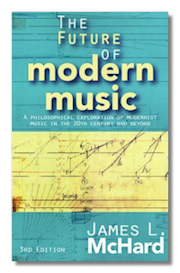
- The Future of Modern Music: A Philosophical Exploration of Modernist Music in the 20th Century and Beyond. James McHard. American Book Publishing. 2001. ISBN 1930586248 (paperback). NEW 3rd Edition pub. 2008: ISBN 0977819515 (paperback).
- A selective survey of the major pioneering composers of the 20th century, this resource focuses on the development of the new emphases in music creation, including tone color and density - elements which prior to 1900 had been subordinated in their treatment and given secondary importance compared to melody and harmony. In addition to presenting general biographies and a list of each of the 123 featured composer's most prominent works, this sourcebook examines the philosophies and the aesthetic considerations behind the new techniques involved in these primary treatments of density and timbre. From Claude Debussy, Gustav Mahler, and Karlheinz Stockhausen to Julio Estrada, Luigi Russolo, and Otomo Yoshihide, this review provides a means of understanding and appreciating the music predominant in the repertoires of most major, modern-day orchestras.
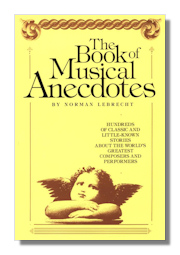
- The Book of Musical Anecdotes. Norman Lebrecht (Editor). Free Press (Macmillan). 1985. ISBN 0029187109 (paperback).
- Arranged chronologically by composer or performer. Begins with a very short biography. Alphabetic list in front of book. Very detailed index. Extracts from the literature on music, with good footnotes and bibliographic information. Here is one of the most enjoyable and illuminating books ever published for the music lover, a feast of delightful anecdotes that reveal the all-too-human side of the great composers and performers. There are stories of appetites (Handel eating dinner for three), embarrassments (Brahms falling asleep as Liszt plays), oddities (Bruckner's dog being trained to howl at Wagner), and devotions (a lovely admirer disrobing in tribute to Puccini). There are memorable accounts of Stravinsky telling Proust how much he hates Beethoven, of Tchaikovsky's first bewildering telephone call, of Dvorak's strange love of pigeons, and of Verdi's intricate maneuvering to keep the now-famous melody of "La donna è mobile" top secret. There is also wonderful trivia (Beethoven loved to eat "bread soup" made with ten raw eggs), along with eccentric strategies (Verdi, disturbed by the sound of street organs playing arias from his operas, hired them all for a season and kept them locked in a room). There are examples of musicians munificent generosity (Haydn called Mozart "the greatest composer known to me, either in person or by name"), and scathing dismissal ("Have you heard any Stockhausen?" the conductor Sir Thomas Beecham was asked. "No," he replied, "but I believe I have trodden in some"). Collected from thousands of books, articles, and unpublished manuscripts (with historical sources provided in extensive notes), these anecdotes appear in their original form, throwing fresh light on familiar figures in the musical hall of fame. For browsing, reading, research and amusement, this book is a grand entertainment for concert-goers, record-buyers, operamanes, gossips and music lovers everywhere.
- Mozart's Death - Mozart's Requiem. Brendan Cormican. Amadeus Trust (Belfast). 1991. ISBN 0951035703 (hardcover).
- Examines the various murder theories and medical records from the Vienna archives and provides more information on the Requiem commission. Web pictures at http://www.angelfire.com/bc2/mozart.